
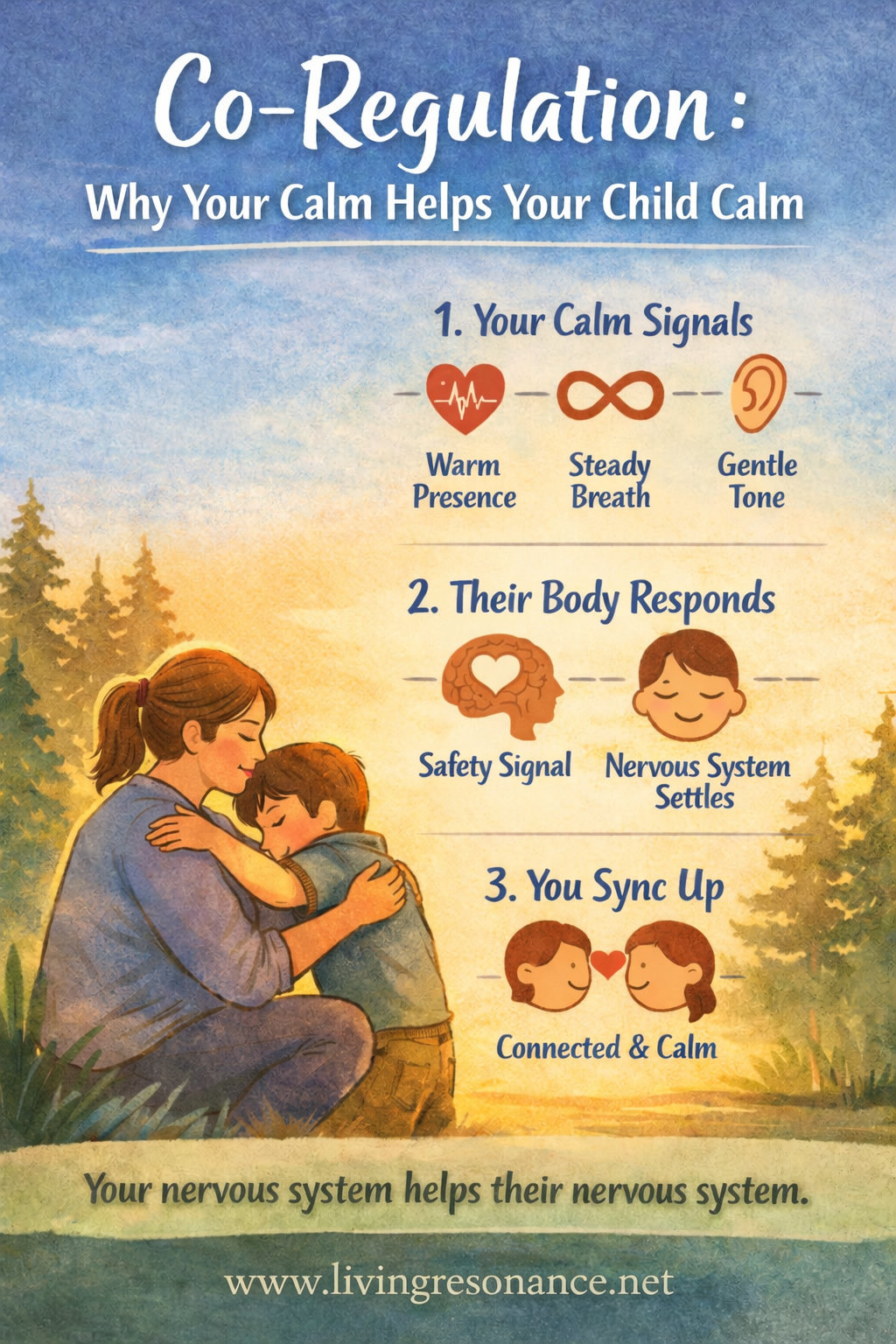
Co-Regulation: Why Your Calm Helps Your Child Calm
If you’ve ever tried to explain something to your child in the middle of a meltdown—and it made everything worse—you’re not alone.
I see this all the time with families.
When kids are overwhelmed, their nervous system isn’t in “learning mode.” It’s in survival mode. That means logic, consequences, and long talks usually don’t land (even when you’re being kind).
This is where co-regulation becomes one of the most powerful tools a parent can learn.
💞 What Is Co-Regulation?
Co-regulation means your nervous system helps your child’s nervous system return to safety.
It’s not about being a perfect parent. It’s not about never getting frustrated.
It’s simply this: your presence is information to your child’s body.
Your tone, your pace, your breath, your face, and your energy are constantly communicating:
“You’re safe.”
“I can handle this.”
“We’re going to get through it.”
And when your body sends those signals clearly, your child’s system has a much better chance of settling.
🧠 Why Talking Doesn’t Work During Big Feelings
When a child is dysregulated, the thinking brain goes offline. You can literally see it happen.
In those moments, your child might:
yell or run
refuse
shut down
cry hard
cling or push you away
This isn’t “bad behavior” as much as it is an overwhelmed nervous system.
So the goal in the moment is not “teach the lesson.”
The goal is: help the body come back online.
Then we can talk.
💓 Where Coherence Fits In
This is one reason I care so much about coherence work.
When a parent can recenter quickly—just a little—the whole tone of the moment changes. Co-regulation becomes easier, and the episode often resolves faster.
If you want the simple explanation of coherence (and how I use HeartMath® + HRV tools), you can read:
What Is Coherence? (Blog Post #1)
Breathwork & HRV for Kids: Why It Works (Blog Post #2)
🌬️ A 30-Second Parent Reset (Real Life Version)
You can do this in a kitchen, hallway, or car. You don’t need silence. You don’t need a meditation cushion.
1) Drop your shoulders
Unclench your jaw. Relax your hands.
2) Slow your exhale
A longer exhale tells the nervous system: “we’re okay.”
3) Add one true feeling
Not fake positivity—just something real, like:
“I’m here.”
“I can handle this moment.”
“My child is having a hard time (not giving me a hard time).”
or even: “Let me get steady first.”
This is often enough to shift what happens next.
👧 What Co-Regulation Can Look Like With Kids
Co-regulation is usually less words, more steadiness.
Some examples:
getting down at their level (not towering over)
lowering your voice instead of raising it
slowing your movements
offering one simple phrase:
“I’m here.”
“You’re safe.”
“We’ll talk after your body feels better.”
If your child wants touch, a steady hand on the back or a hug can help.
If they don’t want touch, just staying close and calm still matters.
🌪️ If You’re Triggered Too (Because You’re Human)
Sometimes your child’s nervous system activates yours.
That doesn’t mean you’re failing.
It means this moment is asking for regulation from both of you.
One parent described it perfectly:
“When I recenter, I can respond with more empathy and help my child regulate.” —Chelsea, Parent
That’s the heart of this work. You don’t have to be perfect. You just have to be willing to come back.
🌲 What Makes Living Resonance Different
At Living Resonance, we don’t just talk about regulation—we practice it in ways that work for real families.
Depending on the child, we may use:
HeartMath® HRV biofeedback (kids can see the shift in real time)
breath + emotional awareness tools that are simple and evidence-based
nature-based practices (movement and outdoors often help faster)
stories, visuals, art, and gentle “body-first” strategies
tools like the Luna Deck for emotional language + regulation pathways
Sessions are supportive, non-clinical, and adapted to your child’s rhythm.
We’re not here to “fix” anyone.
We’re here to help your family build a repeatable pathway back to steadiness—especially when life gets hard.
📍Want Support?
Living Resonance offers:
HeartMath® HRV assessments (kids + adults)
1-on-1 sessions for emotional regulation and nervous system support
family workshops + small group offerings in Los Alamos, NM
[ 👉 Book a Session ] or [ Contact Me ] to ask questions and find the right next step.
🧾 Further Reading (Optional)
If you want to explore the science of co-regulation and nervous system synchrony, here are a few grounded starting points:
Tronick, E. Z. (Still Face research) — classic work showing how infants/children react when a caregiver’s attunement drops, and how repair restores regulation.
Porges, S. W. (Polyvagal Theory) — foundational framework connecting safety cues, social engagement, and regulation (helpful for explaining “why tone and presence matter”).
Feldman, R. (biobehavioral synchrony) — research on parent-child physiological/emotional synchrony and why regulation is relational.
Coan, J. A. (Social Baseline Theory; co-regulation) — evidence that humans regulate better with supportive connection than alone.
Thayer, J. F. & Lane, R. D. (Neurovisceral integration) — foundational work linking HRV with emotional regulation networks.
Shaffer, F. & Ginsberg, J. P. (HRV overview paper) — helpful general reference on HRV metrics and interpretation.
Lehrer, P. et al. (HRV biofeedback literature) — broader evidence base that HRV biofeedback can improve stress resilience and emotional/physical health.
McCraty & Shaffer (2015) — the HRV paper you already cite (still a good anchor reference).
